

Lab 36 – Memory: ballooning, KSM, hugepages, NUMA and overcommit
Dependencies
Section titled “Dependencies”- Previous labs:
- Lab 35: QEMU process and monitor;
- Lab 18:
desopve04is a standalone node again, withlocal-lvmand 16 GiB of RAM. All the tests in this lab are run there, so the memory pressure does not affect the cluster; - Lab 19: the cloud image in
local:importondesopve04; - Lab 23, Lab 24 and Lab 25: CTs 401-404 running on
desopve04, which count toward the node’s used memory; - Lab 05: the DC’s SSH key, authorized on the node and copied into the VMs.
- Resources: the cloud image
debian-13-genericcloud-amd64.qcow2inlocal:importondesopve04, used to create three identical VMs with cloud-init, covered in depth in Lab 40. - Addresses: test VMs 360, 361 and 362 on 172.27.199.160-162.
- Credentials:
root/<lab-password>→ Appendix B.
Objectives
Section titled “Objectives”- Understand how Proxmox VE uses ballooning and when it triggers it on its own.
- Measure the savings of KSM on identical VMs.
- Use 2 MiB and 1 GiB hugepages and know what you give up.
- Give a VM a NUMA topology and read it from the guest.
- See what happens when the memory of the VMs exceeds that of the node, with and without ballooning.
How it works
Section titled “How it works”The RAM of a VM is memory of the QEMU process on the node. It is allocated only when the guest actually uses it; this is why the sum of the configured memory can exceed the physical memory (overcommit). The mechanisms to manage it:
- Ballooning. The guest runs a driver,
virtio_balloon, that can “inflate” a memory balloon: it takes pages away from the guest and returns them to the node. In Proxmox VE you configure two values: Memory, the maximum, and Minimum memory, the minimum. Thepvestatdservice checks the node’s RAM every 10 seconds:- above 80% usage, it lowers the balloon target of the VMs, in proportion to their Shares, down to the minimum;
- below 80%, it brings all the VMs back to the maximum.
- KSM (Kernel Samepage Merging). The kernel thread
ksmdlooks for identical memory pages across different processes and keeps a single copy of them, copy-on-write. With many identical VMs the savings are considerable. Theksmtunedservice turns it on only when the node’s free RAM drops below 20%. - Hugepages. Pages of 2 MiB or 1 GiB instead of 4 KiB: fewer entries in the page tables and in the CPU’s TLB, and therefore less overhead for large VMs with a lot of active memory. They are reserved memory: no ballooning, no KSM, no swap.
- NUMA. In servers with multiple processors, each socket has its own “nearby” memory. A VM that sees the same topology (
numa: 1) can keep processes and memory on the same NUMA node.
Procedure
Section titled “Procedure”1. The test VMs
Section titled “1. The test VMs”Three identical Debian 13 VMs on desopve04, with 3 GiB of maximum memory and 1 GiB minimum, disk on local-lvm:
for id in 360 361 362; do qm create $id --name mem-$id --memory 3072 --balloon 1024 --cores 2 --cpu host --ostype l26 \ --net0 virtio,bridge=vmbr0 --scsihw virtio-scsi-single \ --scsi0 local-lvm:0,import-from=local:import/debian-13-genericcloud-amd64.qcow2 \ --ide2 local-lvm:cloudinit --boot order=scsi0 \ --ipconfig0 ip=172.27.199.$((id-200))/24,gw=172.27.199.1 --nameserver 172.27.199.20 \ --ciuser labuser --sshkeys /root/.ssh/authorized_keys --serial0 socket --vga serial0 qm resize $id scsi0 8G qm start $iddoneLog in to the guests from the DC with ssh [email protected] (and .161, .162) and install stress-ng and numactl through the lab proxy:
echo 'Acquire::http::Proxy "http://proxy.proxmox.community:3128";' | sudo tee /etc/apt/apt.conf.d/90proxysudo apt-get update && sudo apt-get install -y stress-ng numactlIn Hardware → Memory → Edit, with Advanced enabled, you find all the options:
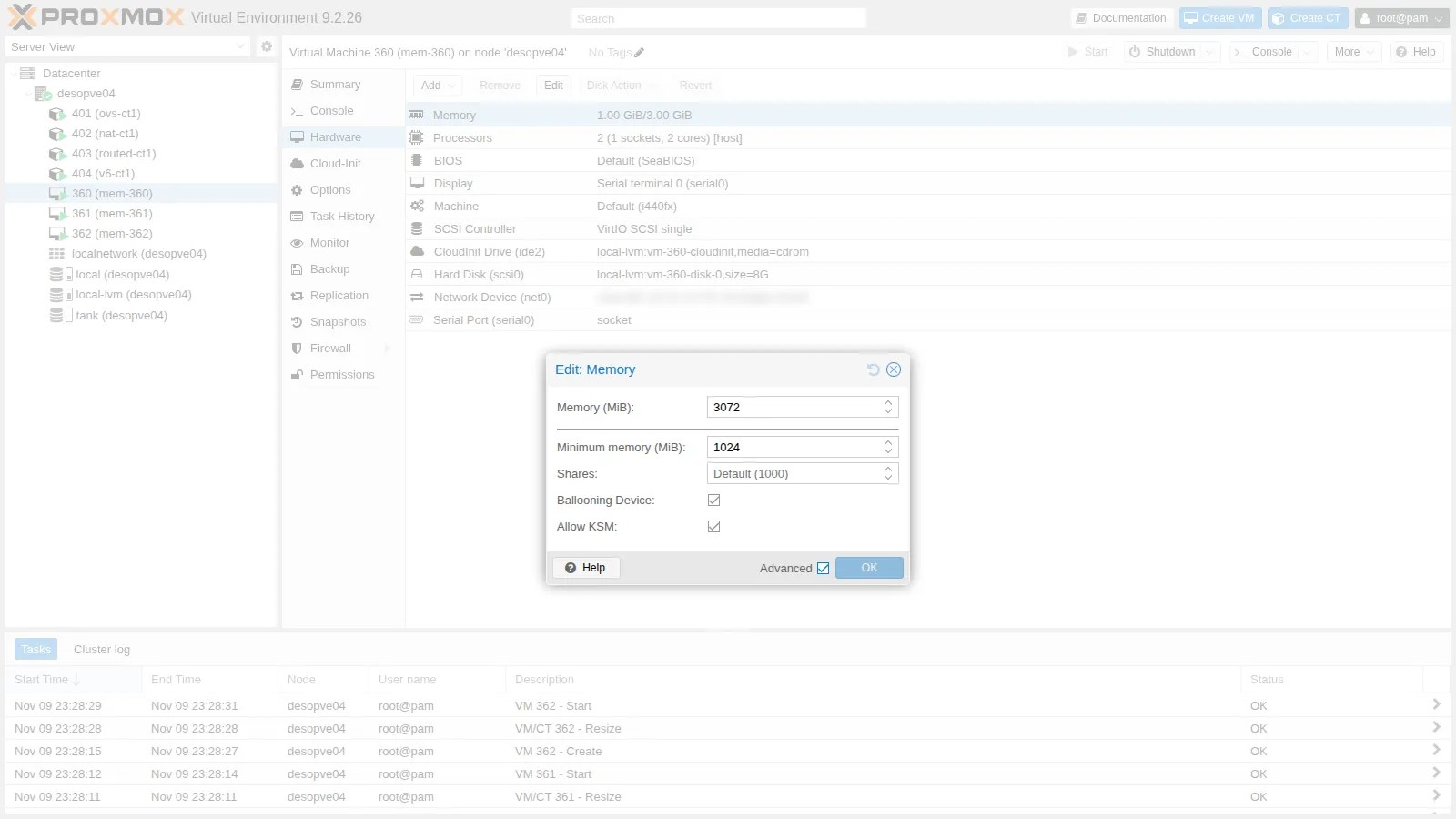
- Ballooning Device: the
virtio-balloondevice. It is needed even if maximum and minimum are the same, because it provides the guest’s memory statistics to the GUI. - Allow KSM: allows KSM to merge the pages of this VM. Clear it for VMs with sensitive data, to avoid the side channel risks between VMs that share pages.
2. The balloon in action
Section titled “2. The balloon in action”The driver is loaded in the guest, and the monitor shows the memory the guest actually owns (actual):
virtio_balloon         32768  0               total        used        free      shared  buff/cache   availableMem:            2979         248        2176           0         703        2731
balloon: actual=3072 max_mem=3072 total_mem=2979 free_mem=2179 ...
Ask the balloon to bring the VM down to 1.5 GiB and read actual every 2 seconds:
printf "balloon 1536\nquit\n" | qm monitor 360 2s actual=2886 4s actual=2886 6s actual=2886 8s actual=298610s actual=298612s actual=298614s actual=298616s actual=3072Mem: 2793 333 1905 0 703 2459 ← in the guest, after 5 sThe guest starts giving up memory (the total drops to 2793 MiB), but after a few seconds it goes back to 3072. The reason: the node is idle, below 80%, so on its next cycle pvestatd sets the target back to the maximum. With Proxmox VE the balloon is not controlled by hand: the node manages it based on its RAM. You will see it at work in step 6.
3. KSM on three identical VMs
Section titled “3. KSM on three identical VMs”ksmtuned is active but KSM is stopped, because the node has more than 20% free RAM:
/sys/kernel/mm/ksm/run: 0KSM_THRES_COEF=20 (default)Mem: 15991 5230 9647 47 1447 10760For the test, stop ksmtuned, which would otherwise turn KSM off within a minute, and turn KSM on with a faster scan rate:
systemctl stop ksmtunedK=/sys/kernel/mm/ksmecho 1000 > $K/pages_to_scan; echo 20 > $K/sleep_millisecs; echo 1 > $K/run 30s pages_shared=82740 pages_sharing=98328 risparmio=384 MiB 60s pages_shared=165975 pages_sharing=378346 risparmio=1477 MiB 90s pages_shared=166168 pages_sharing=379811 risparmio=1483 MiB120s pages_shared=166168 pages_sharing=380078 risparmio=1484 MiB180s pages_shared=166170 pages_sharing=380495 risparmio=1486 MiBgeneral_profit: 1443 MiBMem: 15991 3395 11483 48 1447 12596360 RSS=915 MiB361 RSS=951 MiB362 RSS=954 MiBpages_shared: the unique pages kept in memory.pages_sharing: how many process pages point to those copies, that is, the pages saved.general_profit: the net gain, after deducting the management overhead: 1443 MiB.
In three minutes the node’s used RAM dropped from 5230 to 3395 MiB: three VMs that occupied about 2.8 GiB now use half of that. They are three VMs with the same freshly booted operating system, so kernel, libraries and zeroed pages almost all coincide. With different VMs and real workloads the savings are smaller. The value can also be read in the node’s Summary, under KSM sharing:

The cost is CPU: ksmd scans memory continuously. This is why ksmtuned turns it on only under pressure. Return to the starting situation by unmerging the merged pages and restarting the service:
echo 2 > $K/run # unmerges all merged pages and stops ksmdecho 100 > $K/pages_to_scansystemctl start ksmtuned4. 2 MiB and 1 GiB hugepages
Section titled “4. 2 MiB and 1 GiB hugepages”Reserve 1600 pages of 2 MiB (3.1 GiB) and configure VM 362. Hugepages require NUMA to be enabled; ballooning cannot be used, so it is disabled:
qm shutdown 362echo 1600 > /proc/sys/vm/nr_hugepagesqm set 362 --numa 1 --hugepages 2 --balloon 0qm start 362HugePages_Total: 1600 ← before startupHugePages_Free: 1600 -object 'memory-backend-file,id=ram-node0,size=3072M,mem-path=/run/hugepages/kvm/2048kB,share=on,prealloc=yes' \ -numa 'node,nodeid=0,cpus=0-1,memdev=ram-node0' \HugePages_Total: 1536 ← after startupHugePages_Free: 0The VM’s memory is now a file in the hugetlbfs filesystem (/run/hugepages/kvm/2048kB), entirely allocated at startup (prealloc=yes). The total dropped from 1600 to 1536, exactly 3072 MiB: Proxmox VE allocates and frees the hugepages on its own when the VM starts and shuts down, as many as needed. With keephugepages: 1 it keeps them even after shutdown, to be sure they are still available.
1 GiB pages are even more efficient, but the memory must be found in contiguous blocks. With a CPU that has the pdpe1gb flag, and right after the node has booted, they can also be reserved at runtime:
qm shutdown 362 # it was running with the 2 MiB pages, which Proxmox VE frees at shutdownH=/sys/kernel/mm/hugepages/hugepages-1048576kBecho 3 > $H/nr_hugepagesqm set 362 --hugepages 1024 && qm start 3621G richieste 3, allocate 3, libere 3 -object 'memory-backend-file,id=ram-node0,size=3072M,mem-path=/run/hugepages/kvm/1048576kB,share=on,prealloc=yes' \1G libere dopo l'avvio: 0On a node that has been running for a long time, memory is fragmented and runtime allocation can fail. In production, 1 GiB pages are reserved at boot, on the kernel command line (hugepagesz=1G hugepages=N in /etc/kernel/cmdline with systemd-boot, or in GRUB). They make sense for large VMs with a lot of active memory (databases, analytics), not for small VMs.
At the end, VM 362 goes back to normal: no hugepages, NUMA off, ballooning with a 1 GiB minimum. The reserved pages are released:
qm shutdown 362qm set 362 --delete hugepages,numa --balloon 1024echo 0 > $H/nr_hugepagesqm start 3625. NUMA
Section titled “5. NUMA”The node has a single NUMA node:
numactl -H | grep -E "available|size"available: 1 nodes (0)node 0 size: 15991 MBGive VM 361 two virtual sockets with one NUMA node each. Each virtual node is bound (policy=bind) to host node 0:
qm set 361 --sockets 2 --cores 1 --numa 1 \ --numa0 cpus=0,hostnodes=0,memory=1536,policy=bind \ --numa1 cpus=1,hostnodes=0,memory=1536,policy=bindqm reboot 361 -smp '2,sockets=2,cores=1,maxcpus=2' \ -object 'memory-backend-ram,id=ram-node0,size=1536M,host-nodes=0,policy=bind' \ -numa 'node,nodeid=0,cpus=0,memdev=ram-node0' \ -object 'memory-backend-ram,id=ram-node1,size=1536M,host-nodes=0,policy=bind' \ -numa 'node,nodeid=1,cpus=1,memdev=ram-node1' \In the guest:
available: 2 nodes (0-1)node 0 cpus: 0node 0 size: 1335 MBnode 1 cpus: 1node 1 size: 1511 MBnode distances:node 0 1 0: 10 20 1: 20 10Socket(s): 2NUMA node(s): 2The guest sees two nodes with the distance table (10 local, 20 remote) and can choose where to place processes and memory. On this node it is only a demonstration; on a two-socket server the rule is:
- if the VM fits within one physical socket (vCPUs and RAM),
numa: 1is enough; - if it is larger than one socket, give it the same topology as the host, with
numaNandhostnodesmatching the physical nodes.
This way the vCPUs use nearby memory and do not cross the interconnect between the sockets.
6. Overcommit: with and without ballooning
Section titled “6. Overcommit: with and without ballooning”The three VMs are raised to 5 GiB each, 15 GiB in total on a 16 GiB node that also hosts four containers and the system itself. In each VM, start a process that allocates and holds 4.5 GiB for almost three minutes:
stress-ng --vm 1 --vm-bytes 4500M --vm-keep --timeout 170sOn the node, every 20 seconds, read RAM, swap and the memory each VM actually owns (actual).
Test 1 – ballooning enabled (1 GiB minimum):
0s host usato= 7322 MiB libero= 7555 MiB swap= 0 MiB | balloon(MiB): 360=5081 361=4449 362=4842 20s host usato=14643 MiB libero= 1194 MiB swap= 974 MiB | balloon(MiB): 360=5020 361=4449 362=4842 40s host usato=15217 MiB libero= 619 MiB swap= 972 MiB | balloon(MiB): 360=5020 361=4178 362=4642 60s host usato=14553 MiB libero= 1282 MiB swap= 971 MiB | balloon(MiB): 360=5020 361=4149 362=4442 80s host usato=15003 MiB libero= 828 MiB swap= 970 MiB | balloon(MiB): 360=5020 361=4149 362=4242100s host usato=13914 MiB libero= 1916 MiB swap= 970 MiB | balloon(MiB): 360=5020 361=4104 362=3942120s host usato=13249 MiB libero= 2582 MiB swap= 969 MiB | balloon(MiB): 360=4920 361=3849 362=3742140s host usato=10535 MiB libero= 5295 MiB swap= 969 MiB | balloon(MiB): 360=5020 361=3849 362=3642In guests 361 and 362:
[ 193.834654] Out of memory: Killed process 753 (stress-ng-vm) total-vm:3627660kB, anon-rss:3538844kB, ... oom_score_adj:1000[ 174.139589] Out of memory: Killed process 749 (stress-ng-vm) total-vm:3405184kB, anon-rss:3331028kB, ... oom_score_adj:1000Once 80% is exceeded, pvestatd inflates the balloons of 361 and 362 (from 4.4-4.8 to 3.6-3.8 GiB). The guests, which have no swap, run out of memory and their OOM killer terminates the largest process. The node stays up, with less than 1 GiB of swap used.
Test 2 – ballooning disabled (balloon: 0, fixed memory):
0s host usato= 3034 MiB libero=12731 MiB swap= 909 MiB load=1.50 20s host usato=15672 MiB libero= 215 MiB swap= 1585 MiB load=2.22 40s host usato=15713 MiB libero= 195 MiB swap= 2043 MiB load=2.88 80s host usato=15759 MiB libero= 148 MiB swap= 2043 MiB load=3.98120s host usato=15675 MiB libero= 232 MiB swap= 2043 MiB load=4.48160s host usato=15707 MiB libero= 199 MiB swap= 2043 MiB load=4.45stress-ng: info: [737] successful run completed in 2 mins, 50.18 secs ← all three VMsNo process is killed in the guests, but the node runs at its limit: less than 250 MiB free for three minutes, 2 GiB in swap and a growing load. At that point the node is fragile: a container starting, a backup or a growing ZFS cache can trigger the node’s OOM killer, which usually picks the largest process, that is, an entire VM, killed without warning.
| Ballooning enabled | Ballooning disabled | |
|---|---|---|
| Minimum free RAM on the node | 619 MiB | 148 MiB |
| Node swap | about 1 GiB | 2 GiB and more |
| Effect | the guests lose their largest process | the guests complete, the node risks losing a VM |
| Who pays | the guest that consumes the memory | the whole node |
Ballooning moves the problem into the VMs that consume too much, where an administrator can see it and deal with it, instead of leaving it to the node. It is no substitute for proper sizing: the sum of the VMs’ minimums must fit comfortably in the node’s RAM.
Verification and tests
Section titled “Verification and tests”- The
virtio_balloondriver is loaded in the guest andinfo balloonreports the actual memory. - KSM: more than 380,000 shared pages and 1.44 GiB of net gain on three identical VMs, also visible in the node’s Summary.
- 2 MiB and 1 GiB hugepages used by the VM (
memory-backend-fileonhugetlbfs) and released at shutdown. - The guest with
numa: 1and two sockets sees two NUMA nodes with the correct distances. - Overcommit measured in both modes.
Final lab state
Section titled “Final lab state”- VMs 360, 361 and 362: deleted with
qm stop <id> && qm destroy <id> --purge; the node’s swap was emptied withswapoff -a && swapon -a. - desopve04: back to how it was.
- KSM:
run=0, controlled by the activeksmtuned, default parameters. - Hugepages: none reserved.
- Swap: emptied (
swapoff -a && swapon -a). - CTs 401-404: running and untouched.
- KSM:
- No changes to the cluster.
What you learned
Section titled “What you learned”- In Proxmox VE the balloon is driven by
pvestatdbased on the node’s RAM: below 80% the VMs go back to the maximum, above it they shrink toward the minimum according to their Shares. - KSM can save a lot of memory with similar VMs, at the cost of CPU;
ksmtunedturns it on only under pressure, and the Allow KSM option excludes sensitive VMs. - Hugepages reduce overhead for large VMs but are reserved memory: no ballooning, KSM or swap. Proxmox VE allocates them when the VM starts; 1 GiB pages are best reserved at node boot.
- The NUMA topology of the VM matters when the VM is larger than a physical socket.
- Overcommit works as long as the VMs do not actually use all their memory; with ballooning the problem stays inside the guests, without putting the whole node at risk.