

Lab 29 – SDN 3: VXLAN zone
Dependencies
Section titled “Dependencies”- Previous labs:
- Physical network: the node ports are a trunk; this lab uses VLAN 61 for the underlay network
10.61.10.0/24. - Nodes:
desopve01,desopve02,desopve03. - Template:
cephfs:vztmpl/debian-13-standard_13.6-1_amd64.tar.zst. - Credentials:
root/<lab-password>on the nodes and in the containers → Appendix B.
Objectives
Section titled “Objectives”- Understand how VXLAN carries a layer 2 network over an IP network.
- Prepare a dedicated underlay network and measure its MTU.
- Create a VXLAN zone with a VNet present on all nodes and connect guests on different nodes to it.
- See the VXLAN packets between the nodes with
tcpdump. - Understand what happens when the guests’ MTU is wrong and how to set it correctly.
How it works
Section titled “How it works”Overlay and underlay
Section titled “Overlay and underlay”VXLAN (RFC 7348) takes a guest’s Ethernet frame, adds an 8-byte VXLAN header to it and sends it inside a UDP packet (port 4789) from one node to another. The node that encapsulates and decapsulates is called a VTEP (VXLAN Tunnel End Point).
- The network between the VTEPs is the underlay: a normal IP network between the nodes.
- The network the guests see is the overlay: a single layer 2 segment that exists on all nodes, even if the underlay went through a router.
- Each overlay network has a 24-bit VNI (VXLAN Network Identifier): up to 16 million networks, versus 4094 VLANs.
The Proxmox VE VXLAN zone
Section titled “The Proxmox VE VXLAN zone”In the VXLAN zone you list the underlay addresses of all nodes (Peer Address List). There is no control protocol:
- broadcast, multicast and unknown destinations (for example ARP requests) are copied to every peer (head-end replication);
- each node learns behind which VTEP a MAC lives by observing the traffic (flood and learn), like a switch.
For large networks, or to get distributed routing and gateways, there is the EVPN zone, which uses BGP as its control plane (lab 30).
The cost in bytes: the MTU
Section titled “The cost in bytes: the MTU”| Added header | Bytes |
|---|---|
| Guest Ethernet (carried inside the tunnel) | 14 |
| VXLAN | 8 |
| UDP | 8 |
| Outer IPv4 | 20 |
| Total | 50 |
With a 1500-byte underlay, the guest is left with an MTU of 1450 bytes. In production you raise the underlay MTU (at least 1550, usually 9000-byte jumbo frames), so the guests keep 1500.
Why a dedicated VLAN for the underlay
Section titled “Why a dedicated VLAN for the underlay”- Isolation: VXLAN is neither encrypted nor authenticated. Anyone who can reach UDP port 4789 on the nodes can inject frames into the guest networks, so the underlay must be kept away from networks that others can reach.
- No router in between: on the same VLAN the VTEPs talk to each other directly, without going through the lab gateway.
- Separate performance and MTU: guest traffic does not mix with management and Corosync, and the underlay MTU can be raised without touching the other networks.
Procedure
Section titled “Procedure”1. The underlay network on VLAN 61
Section titled “1. The underlay network on VLAN 61”-
On
desopve01: System → Network → Create → Linux VLAN. Namevmbr1.61(VLAN 61 on the bond’s bridge), IPv4/CIDR10.61.10.21/24, no gateway. Then Apply Configuration.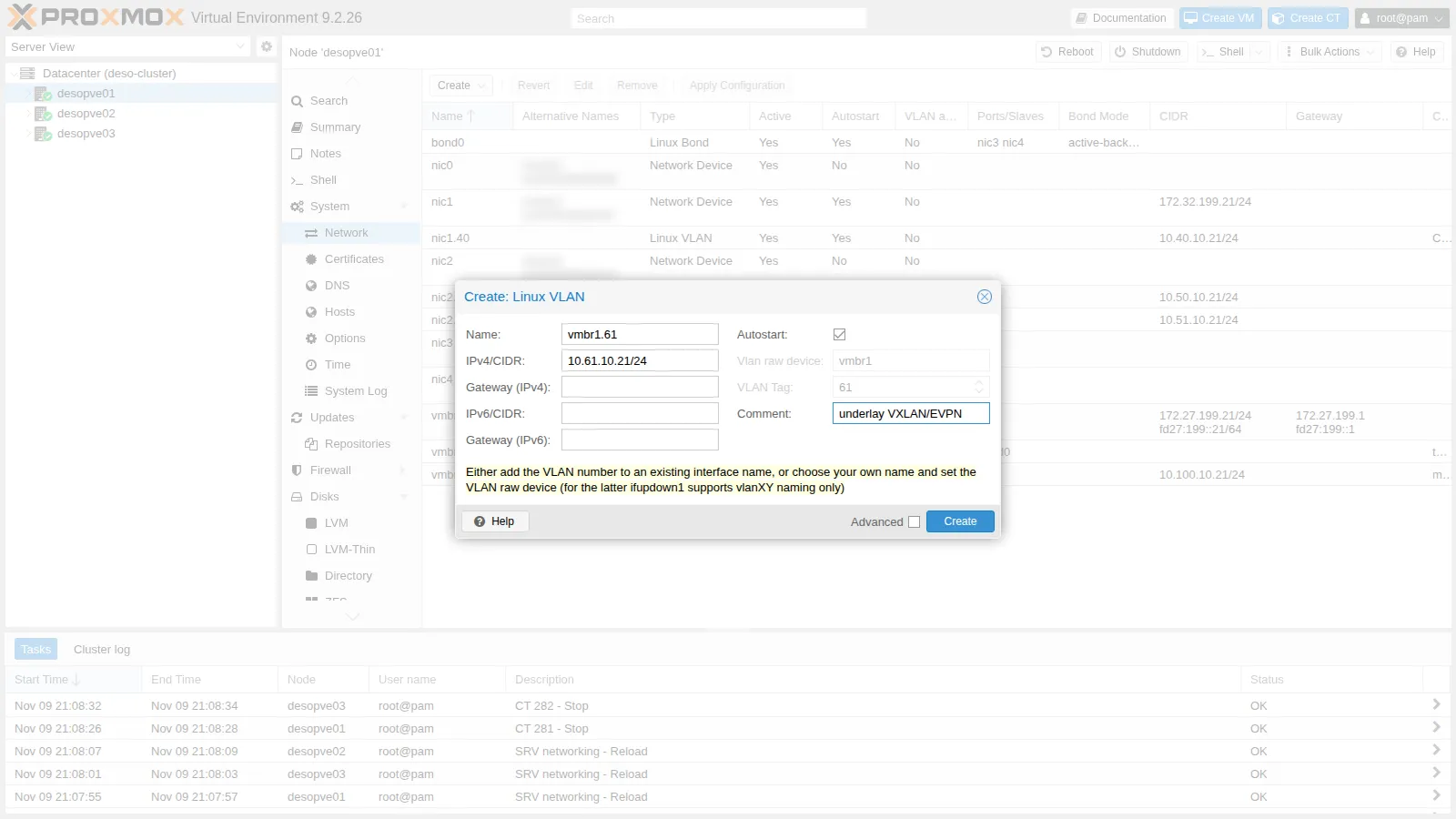
-
On
desopve02anddesopve03, the same block in/etc/network/interfaces, with addresses .22 and .23, before thesourceline:auto vmbr1.61iface vmbr1.61 inet staticaddress 10.61.10.22/24#underlay VXLAN/EVPNroot@desopve02 ifreload -aip -br -4 addr show vmbr1.61Output vmbr1.61@vmbr1 UP 10.61.10.22/24 -
Measure the underlay MTU with the don’t fragment bit: a 1500-byte IP packet (1472 bytes of data + 28 of headers) goes through, a 1501-byte one does not even leave the node.
root@desopve01 ping -c2 -W1 -M do -s 1472 10.61.10.23Output 2 packets transmitted, 2 received, 0% packet loss, time 1024msroot@desopve01 ping -c1 -W1 -M do -s 1473 10.61.10.23Output PING 10.61.10.23 (10.61.10.23) 1473(1501) bytes of data.ping: sendmsg: Message too longThe underlay has an MTU of 1500: the VXLAN VNet will need an MTU of 1450.
2. VXLAN zone and VNet
Section titled “2. VXLAN zone and VNet”-
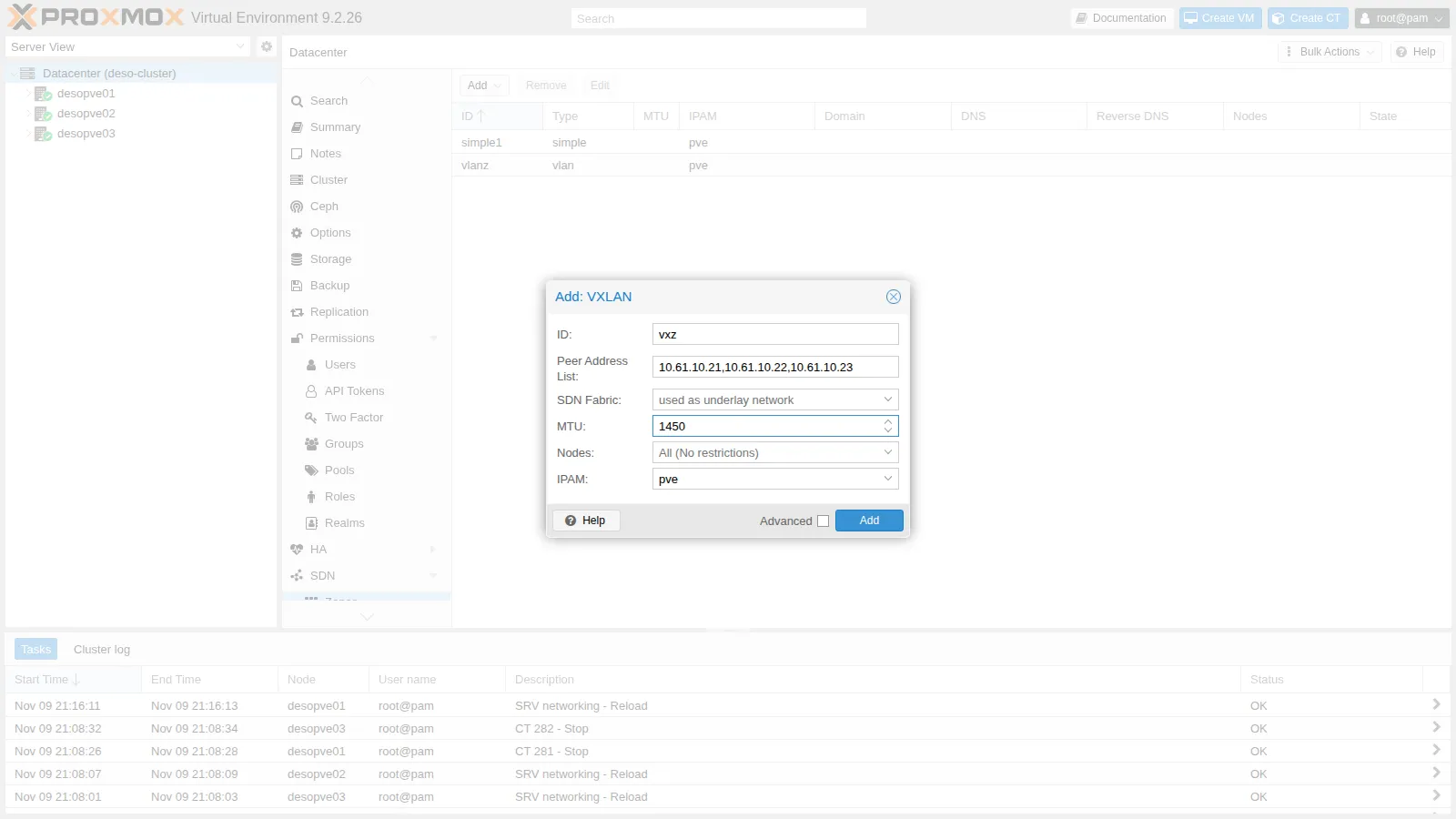
Datacenter → SDN → Zones → Add → VXLAN:
- ID
vxz; - Peer Address List
10.61.10.21,10.61.10.22,10.61.10.23: the underlay addresses of all nodes, including the local one; - MTU
1450.
The SDN Fabric field is the alternative to the peer list: it uses a fabric as the underlay (lab 31).
- ID
-
VNets → Create: Name
vnvx1, Zonevxz, Tag10062. In a VXLAN zone the tag is the VNI.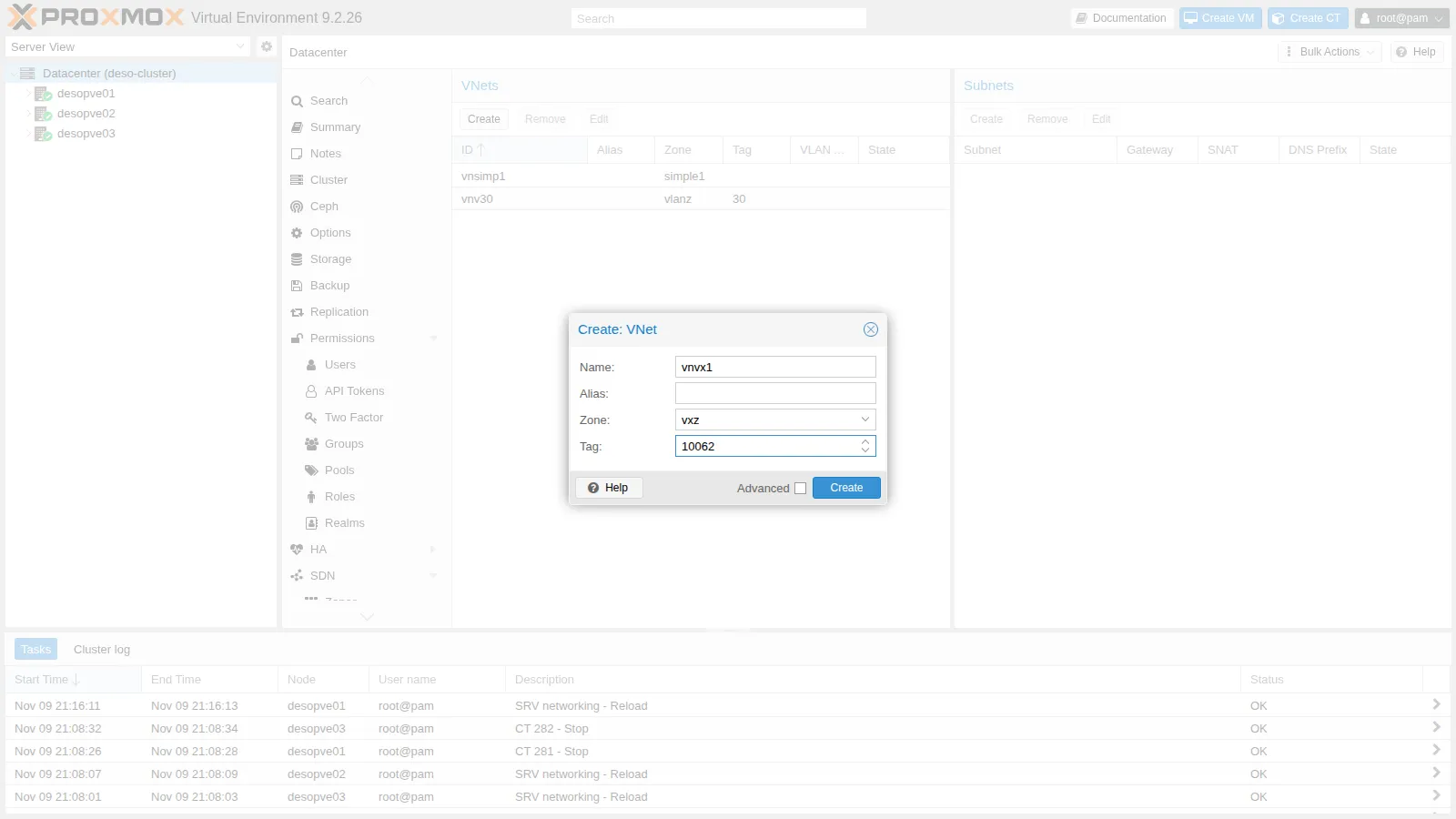
-
Apply and zone status; the same result on all three nodes:
root@desopve01 pvesh set /cluster/sdnpvesh get /nodes/desopve03/sdn/zonesOutput ┌───────────┬─────────┐│ status │ zone │╞═══════════╪═════════╡│ available │ simple1 │├───────────┼─────────┤│ available │ vlanz │├───────────┼─────────┤│ available │ vxz │└───────────┴─────────┘
3. What the SDN generates on every node
Section titled “3. What the SDN generates on every node”-
A VXLAN interface with the VNI, the local address and the other two nodes as destinations, and the VNet bridge that uses it as its port, both with an MTU of 1450:
# excerpt of /etc/network/interfaces.d/sdn on desopve01auto vnvx1iface vnvx1bridge_ports vxlan_vnvx1bridge_stp offbridge_fd 0mtu 1450auto vxlan_vnvx1iface vxlan_vnvx1vxlan-id 10062vxlan-local-tunnelip 10.61.10.21vxlan_remoteip 10.61.10.22vxlan_remoteip 10.61.10.23mtu 1450 -
The kernel confirms the VNI, the local address and the UDP port:
root@desopve01 ip -d link show vxlan_vnvx1 | grep -o "vxlan id .* dstport [0-9]*"Output vxlan id 10062 local 10.61.10.21 srcport 0 0 dstport 4789 -
The two all-zero MAC entries are the head-end replication: every broadcast frame, or frame addressed to an unknown MAC, is copied to both other nodes.
root@desopve01 bridge fdb show dev vxlan_vnvx1 | grep 00:00:00:00:00:00Output 00:00:00:00:00:00 dst 10.61.10.22 self permanent00:00:00:00:00:00 dst 10.61.10.23 self permanent
4. Two guests on different nodes
Section titled “4. Two guests on different nodes”-
One container on
desopve01and one ondesopve03in thevnvx1VNet, with a static address:root@desopve01 pct create 291 cephfs:vztmpl/debian-13-standard_13.6-1_amd64.tar.zst --hostname vxlan-ct1 \--unprivileged 1 --features nesting=1 --cores 1 --memory 512 --rootfs rbd-vm:4 \--net0 name=eth0,bridge=vnvx1,ip=10.62.62.11/24 --passwordpct start 291root@desopve03 pct create 292 cephfs:vztmpl/debian-13-standard_13.6-1_amd64.tar.zst --hostname vxlan-ct2 \--unprivileged 1 --features nesting=1 --cores 1 --memory 512 --rootfs rbd-vm:4 \--net0 name=eth0,bridge=vnvx1,ip=10.62.62.12/24 --passwordpct start 292root@desopve01 pct exec 291 -- ping -c3 -W1 10.62.62.12Output 3 packets transmitted, 3 received, 0% packet loss, time 2042ms -
On the underlay you can see the tunnel: UDP packets to port 4789 with VNI 10062 and, inside, the guest’s ARP request.
root@desopve01 tcpdump -lnni vmbr1.61 -c2 udp port 4789Output 21:19:27.662568 IP 10.61.10.23.38568 > 10.61.10.21.4789: VXLAN, flags [I] (0x08), vni 10062ARP, Request who-has 10.62.62.11 tell 10.62.62.12, length 2821:19:27.662669 IP 10.61.10.21.52130 > 10.61.10.23.4789: VXLAN, flags [I] (0x08), vni 10062ARP, Reply 10.62.62.11 is-at bc:24:11:bb:d8:25, length 28
5. What happens with the wrong MTU
Section titled “5. What happens with the wrong MTU”-
The VNet has an MTU of 1450, and the host has also set its side of the container’s
vethpair to 1450. Inside the container, however, the network interface stayed at 1500:root@desopve01 ip link show veth291i0 | grep -o "mtu [0-9]*"Output mtu 1450root@desopve01 pct exec 291 -- ip link show eth0 | grep -o "mtu [0-9]*"Output mtu 1500 -
Up to 1450 bytes everything goes through; the guest sends a 1500-byte packet, but the host drops it:
root@desopve01 pct exec 291 -- ping -c3 -W1 -M do -s 1422 10.62.62.12Output 3 packets transmitted, 3 received, 0% packet loss, time 2034msroot@desopve01 pct exec 291 -- ping -c3 -W1 -M do -s 1472 10.62.62.12Output ping: sendmsg: No buffer space availableping: sendmsg: No buffer space availableping: sendmsg: No buffer space available3 packets transmitted, 0 received, 100% packet loss, time 3081msHere the container at least gets an error, because it shares the host’s kernel. With other guests the drop can be completely silent: small pings work, large ones vanish.
-
TCP, on the other hand, seems to work. The reason becomes clear when capturing on the host side of the container: at the first oversized segment, the host itself replies with an ICMP fragmentation needed (MTU 1450) on behalf of the tunnel. The guest caches it and from then on uses smaller segments.
root@desopve01 pct exec 291 -- ip route flush cachetcpdump -lnni veth291i0 -c3 "icmp or (tcp port 5001 and tcp[tcpflags] & tcp-syn != 0)"Output 21:22:50.971022 IP 10.62.62.11.47094 > 10.62.62.12.5001: Flags [S], seq 2687240530, win 64240, options [mss 1460,sackOK,TS val 566963034 ecr 0,nop,wscale 10], length 021:22:50.971630 IP 10.62.62.12.5001 > 10.62.62.11.47094: Flags [S.], seq 1554622400, ack 2687240531, win 65160, options [mss 1460,sackOK,TS val 2751837441 ecr 566963034,nop,wscale 10], length 021:22:50.971801 IP 10.62.62.12 > 10.62.62.11: ICMP 10.62.62.12 unreachable - need to frag (mtu 1450), length 556root@desopve01 pct exec 291 -- ip route get 10.62.62.12Output 10.62.62.12 dev eth0 src 10.62.62.11 uid 0cache expires 591sec mtu 1450Start the capture before the transfer that triggers it: 2 MB with
ncfrom CT 291 to CT 292, which arrived complete.ncis already in the Debian template:root@desopve03 pct exec 292 -- sh -c 'nc -l -p 5001 > /dev/null'root@desopve01 pct exec 291 -- sh -c 'head -c 2M /dev/urandom | nc -q1 10.62.62.12 5001'This is Path MTU Discovery: it works as long as the ICMP reaches the guest. A firewall that blocks ICMP (labs 32-33), or a UDP application that sends large packets, is enough for connections to hang without a clear error. That is why the MTU is set on the guests instead of relying on ICMP.
6. Setting the correct MTU on the guests
Section titled “6. Setting the correct MTU on the guests”-
In the container’s network interface, with Advanced checked, set the MTU field to
1450. From the command line:pct set 291 --net0 name=eth0,bridge=vnvx1,hwaddr=BC:24:11:BB:D8:25,ip=10.62.62.11/24,mtu=1450.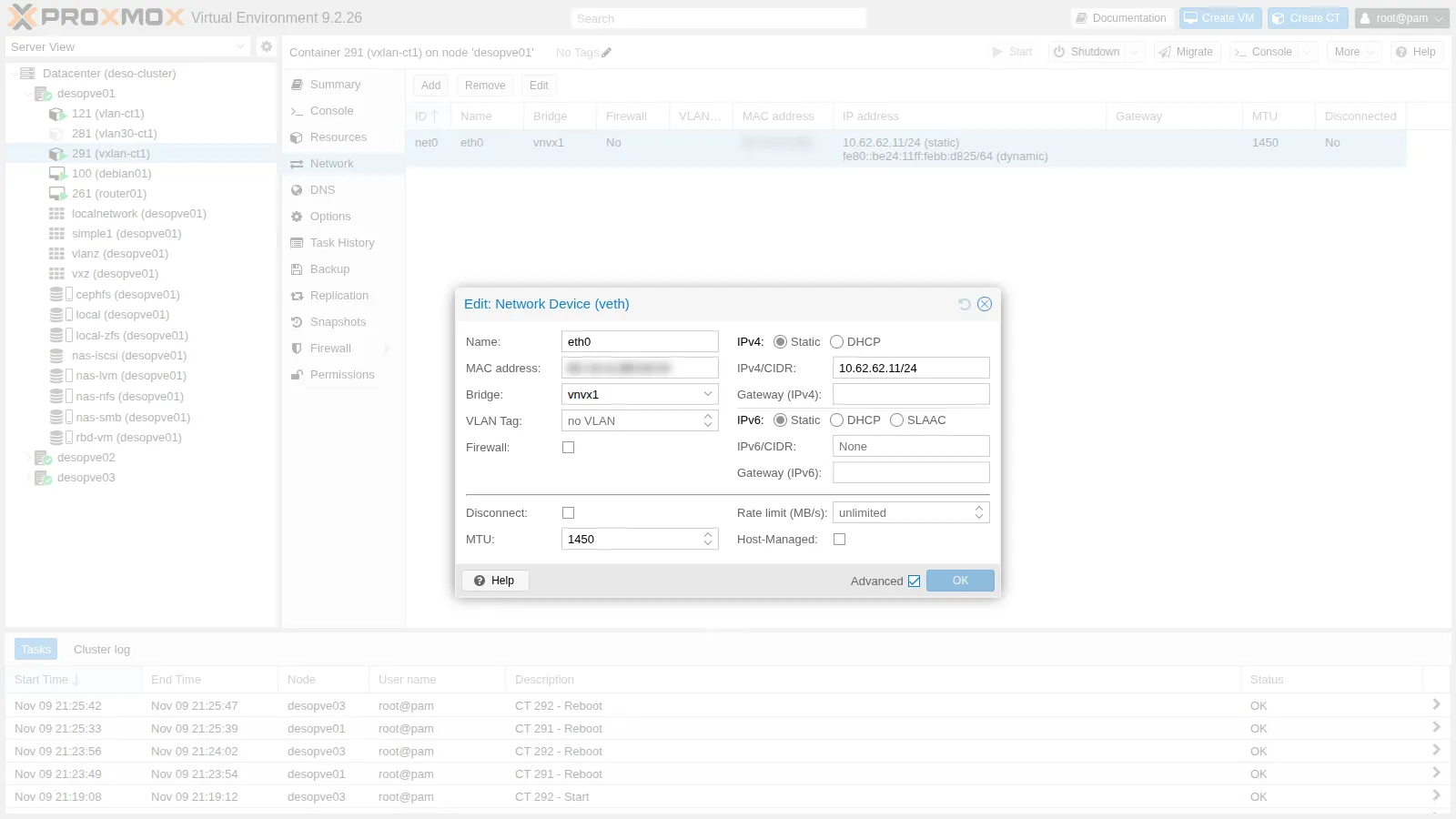
-
A trap with Debian 13 containers: even after a reboot the interface inside the container stays at 1500. Proxmox VE creates the
vethwith the right MTU, but does not write it into the container’s network file, and at bootifupdown2(included in the template) resets interfaces without an explicit MTU to 1500.root@desopve01 grep mtu /var/lib/lxc/291/configOutput lxc.net.0.mtu = 1450root@desopve01 pct exec 291 -- ip link show eth0 | grep -o "mtu [0-9]*"Output mtu 1500The fix is to add
mtu 1450to the interface in the container’s file. Proxmox VE keeps the line when it rewrites the file at every start:root@desopve01 pct exec 291 -- sed -i '/address 10.62.62.11/a\ mtu 1450' /etc/network/interfacespct reboot 291pct exec 291 -- cat /etc/network/interfaces | sed -n '/eth0/,$p'Output auto eth0iface eth0 inet staticaddress 10.62.62.11/24mtu 1450root@desopve01 pct exec 291 -- ip link show eth0 | grep -o "mtu [0-9]*"Output mtu 1450The same for CT 292 on
desopve03. -
Now the oversized packet is rejected right away by the guest, and TCP advertises an MSS of 1410 bytes (1450 − 40) on its own in both directions, with no need for ICMP:
root@desopve01 pct exec 291 -- ping -c1 -W1 -M do -s 1423 10.62.62.12Output PING 10.62.62.12 (10.62.62.12) 1423(1451) bytes of data.ping: sendmsg: Message too longroot@desopve01 pct exec 291 -- ping -c3 -W1 -M do -s 1422 10.62.62.12Output 3 packets transmitted, 3 received, 0% packet loss, time 2038msroot@desopve01 tcpdump -lnni veth291i0 -c2 "icmp or (tcp port 5001 and tcp[tcpflags] & tcp-syn != 0)"Output 21:27:11.768115 IP 10.62.62.11.45450 > 10.62.62.12.5001: Flags [S], seq 4032040915, win 64860, options [mss 1410,sackOK,TS val 3643972739 ecr 0,nop,wscale 10], length 021:27:11.768786 IP 10.62.62.12.5001 > 10.62.62.11.45450: Flags [S.], seq 3506410363, ack 4032040916, win 64308, options [mss 1410,sackOK,TS val 4258233405 ecr 3643972739,nop,wscale 10], length 0A 200 MB transfer between the two containers over the VXLAN takes about 2 seconds, including the startup of
pct exec(with the receiver listening again on CT 292):root@desopve01 time pct exec 291 -- sh -c 'head -c 200M /dev/zero | nc -q1 10.62.62.12 5001'Output real 0m2.497s -
For VMs the field is the same, in the VirtIO network device. According to the Proxmox VE documentation, the value
1makes the device inherit the bridge MTU, hence 1450 on this VNet.
7. The rest of the network has not changed
Section titled “7. The rest of the network has not changed”ceph healthHEALTH_OKpct exec 121 -- ping -c2 -W1 10.10.10.1222 packets transmitted, 2 received, 0% packet loss, time 1001msping -c2 -W1 10.100.10.232 packets transmitted, 2 received, 0% packet loss, time 1058msVerification and tests
Section titled “Verification and tests”| Test | Result |
|---|---|
| Underlay VLAN 61, 1500-byte ping with DF | goes through; 1501 bytes: Message too long |
Zone vxz on 3 nodes |
available on all |
CT 291 (desopve01) → CT 292 (desopve03) |
0% loss, VXLAN with VNI 10062 on the underlay |
| Guest at MTU 1500, 1500-byte ping | 100% loss |
| Guest at MTU 1500, TCP | works only thanks to the host’s ICMP need to frag |
| Guest at MTU 1450 | 1423 bytes rejected by the guest, MSS 1410, 200 MB in 1.6 s |
| Ceph, guest VLAN 10, migration network | unchanged |
Final lab state
Section titled “Final lab state”- Underlay network:
vmbr1.61ondesopve01-desopve03, 10.61.10.21-23/24, VLAN 61, no gateway. - SDN:
- zone
vxz(VXLAN, peers 10.61.10.21-23, MTU 1450) with VNetvnvx1, VNI 10062, no subnet; - zones
simple1andvlanzunchanged.
- zone
- Containers on the VXLAN, running, not set to start at boot, disk on
rbd-vm, MTU 1450 also in the container’s network file:- CT 291
vxlan-ct1ondesopve01, 10.62.62.11/24; - CT 292
vxlan-ct2ondesopve03, 10.62.62.12/24.
- CT 291
What you learned
Section titled “What you learned”- VXLAN carries a layer 2 network inside UDP packets between the nodes: the VNI identifies the network, and the underlay is a normal IP network.
- The Proxmox VE VXLAN zone uses a static peer list and replicates broadcasts to every peer; EVPN adds a control plane.
- Encapsulation costs 50 bytes: with the underlay at 1500 the overlay goes to 1450, or you raise the underlay MTU.
- A guest with the wrong MTU loses large packets, and TCP survives only as long as the ICMP fragmentation needed gets through.
- In Debian 13 containers the MTU must also be written into the container’s network file, otherwise
ifupdown2resets it to 1500.