

Lab 30 – SDN 4: EVPN with BGP, exit nodes and anycast gateway
Dependencies
Section titled “Dependencies”-
Previous labs:
-
Packages:
frrandfrr-pythontoolsare installed by the Proxmox VE ISO; the SDN enables the service and writes/etc/frr/frr.confon Apply. Check withdpkg -l frr frr-pythontoolsandsystemctl is-enabled frr:ii frr 10.6.1-1+pve3 amd64 FRRouting suite of internet protocols (BGP, OSPF, IS-IS, ...)ii frr-pythontools 10.6.1-1+pve3 all FRRouting suite - Python toolsenabled -
Nodes:
desopve01,desopve02,desopve03. -
Images: template
cephfs:vztmpl/debian-13-standard_13.6-1_amd64.tar.zst(Lab 20) and cloud imagelocal:import/debian-13-genericcloud-amd64.qcow2ondesopve01, downloaded in Lab 19. -
Credentials:
root/<lab-password>→ Appendix B.
Objectives
Section titled “Objectives”- An EVPN zone,
evpnz, with its VRF and two VNets, and iBGP sessions with BFD established between the three nodes:vtyshshows the sessions, the VNIs and the MAC/IP routes of the guests. - The same gateway, with the same IP and MAC, on every node (anycast gateway): a container in
vnev2reaches one invnev1on another node, and leaves the zone with the address of the primary exit node (SNAT). - A VM live-migrated to another node with no change to its network configuration, its MAC now advertised behind the new node.
- A simulated failure of the primary exit node, after which you can tell whether the exit has moved to the backup node, and why a flow that was already open may stay blocked.
How it works
Section titled “How it works”The control plane
Section titled “The control plane”In the VXLAN zone of lab 29 each node learned MACs from the traffic and copied broadcasts to every peer. With EVPN (RFC 7432 and 8365) the nodes exchange this information over BGP (address family l2vpn evpn): when a guest starts, its node advertises the guest’s MAC and IP to the others.
| Route type | What it advertises | Example in the lab |
|---|---|---|
| Type 2 (MAC/IP) | a guest’s MAC and IP and the VTEP it sits behind | bc:24:11:ca:34:84 / 10.71.71.11 behind 10.61.10.21 |
| Type 3 (multicast) | which VTEPs participate in a VNI | the three nodes for each VNet |
| Type 5 (IP prefix) | a routable network, for example an exit node’s default route | 0.0.0.0/0 from desopve01 |
The nodes form iBGP sessions with each other using a private ASN (65000) on the underlay network addresses. The SDN also enables BFD on these sessions (neighbor VTEP bfd in the configuration of step 4). With FRR’s default timers, 300 ms between control packets and a multiplier of 3, a neighbor that falls silent is declared down after about 900 ms, without waiting for the BGP timers; vtysh -c "show bfd peers" shows the timers actually in use.
VRF, anycast gateway and distributed routing
Section titled “VRF, anycast gateway and distributed routing”- EVPN zone = VRF. Each zone is a separate routing table (
vrf_evpnz), that is, a tenant: its networks do not mix with those of the host or of other zones. - Anycast gateway. The gateway of each VNet exists on all nodes, with the same IP and the same MAC. A guest always talks to the gateway of the node it runs on, and if it migrates it finds the same gateway.
- Symmetric routing. Traffic between two VNets is routed by the source node and crosses the network between the nodes inside the zone’s layer 3 VNI (VRF-VXLAN tag). The destination node delivers it into the target VNet.
Exit nodes
Section titled “Exit nodes”To leave the zone you need one or more exit nodes: nodes that advertise a default route into the zone and connect the VRF to the host network. With SNAT on the subnet, the guests go out with the exit node’s address. When there are several exit nodes, a Primary Exit Node sends all outgoing traffic through that node while the others stand by; the Proxmox VE documentation requires one if you use SNAT.
SNAT is stateful: the exit node records each flow in its connection tracking table (conntrack) and uses that entry to translate the replies. As in Lab 24, an entry has two halves, the request as the guest sent it and the reply as it is expected to come back. With SNAT, the reply half is addressed to the exit node, not to the guest: step 8 uses this to read what happened during the failure.
Test environment and versions
Section titled “Test environment and versions”The outputs and measurements below come from tests run in November 2026 with this configuration:
| Component | Configuration used |
|---|---|
| Proxmox VE | 9.2.26, kernel 7.0.14-28-pve (Lab 04) |
| FRR | 10.6.1-1+pve3, with the configuration generated by the SDN |
| Underlay | VLAN 61 (vmbr1.61, 10.61.10.0/24) on vmbr1 and bond0, active-backup on 10 GbE ports, MTU 1500 (Lab 21, Lab 29) |
| Zone | exit nodes desopve01 (primary) and desopve02, SNAT on both subnets, guest MTU 1450 |
| Guests | CT 301 and CT 302 from the debian-13-standard_13.6-1 template, VM 303 from the Debian 13 cloud image, all on rbd-vm (Ceph 20.2, Lab 17) |
| Tools | ping from CT 302 every 100 or 200 ms, the migration task log, vtysh, tcpdump, conntrack |
What the tests measure, and what they do not. The failure of the exit node is simulated by bringing down its underlay interface: desopve01 stays up and reachable on the management network, so this is not the crash or the power loss of a node. The traffic is ICMP only; no TCP connection was tested. A ping shows what a client experiences, at the resolution of its interval: it does not time BFD or the BGP convergence, and the moment the interface went down, relative to the ping, was not recorded. The Proxmox VE documentation recommends disabling strict reverse path filtering (rp_filter) when a zone has several exit nodes; its value on the nodes was not recorded.
Procedure
Section titled “Procedure”1. The EVPN controller
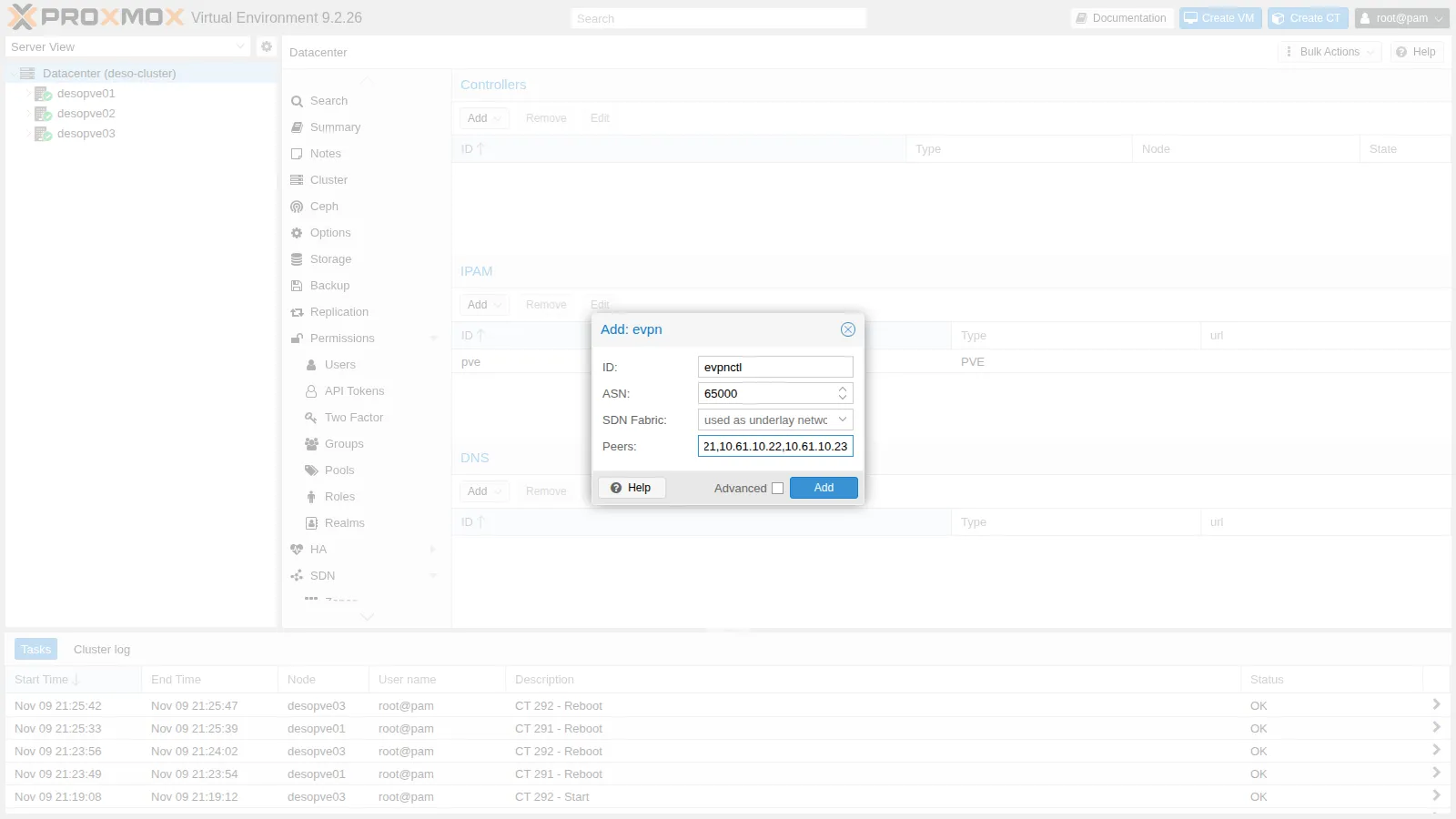
Section titled “1. The EVPN controller”Datacenter → SDN → Options → Controllers → Add → EVPN:
- ID
evpnctl; - ASN
65000, private; - Peers
10.61.10.21,10.61.10.22,10.61.10.23: the underlay addresses of the nodes.
Here too, SDN Fabric is the alternative to the peer list (lab 31).
2. The EVPN zone
Section titled “2. The EVPN zone”-
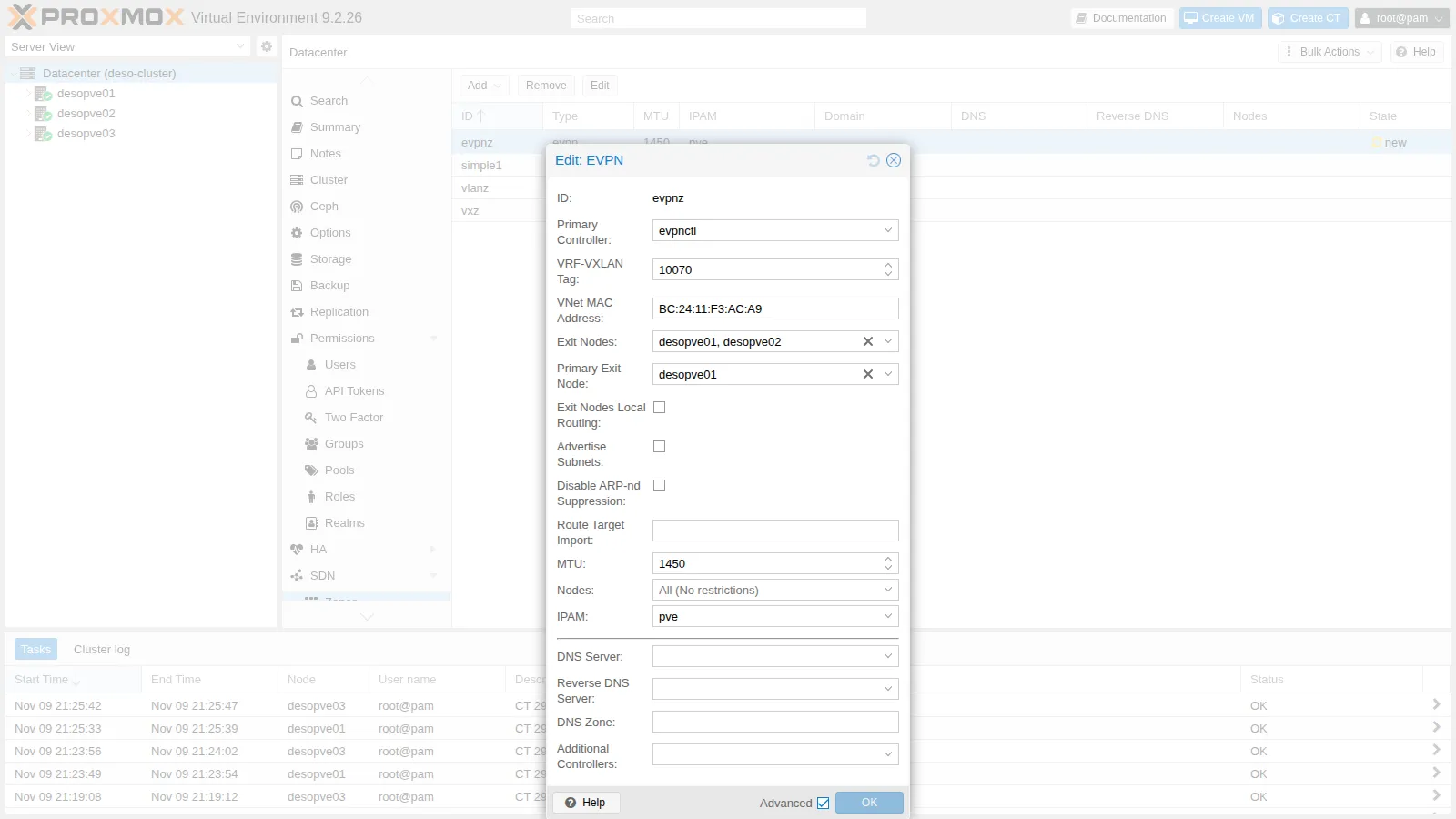
Zones → Add → EVPN, with Advanced checked:
- ID
evpnz, Controllerevpnctl; - VRF-VXLAN Tag
10070: the zone’s layer 3 VNI; - Exit Nodes
desopve01,desopve02; Primary Exit Nodedesopve01; - MTU
1450, as in lab 29.
The VNet MAC Address is generated by Proxmox VE: it is the MAC of the anycast gateway, the same on all nodes.
The primary node can also be set from the command line:
root@desopve01 pvesh set /cluster/sdn/zones/evpnz --exitnodes-primary desopve01 - ID
3. Two VNets with subnet and SNAT
Section titled “3. Two VNets with subnet and SNAT”-
VNets → Create:
vnev1, zoneevpnz, Tag (VNI)10071. In the Subnets panel → Create: Subnet10.71.71.0/24, Gateway10.71.71.1, SNAT enabled: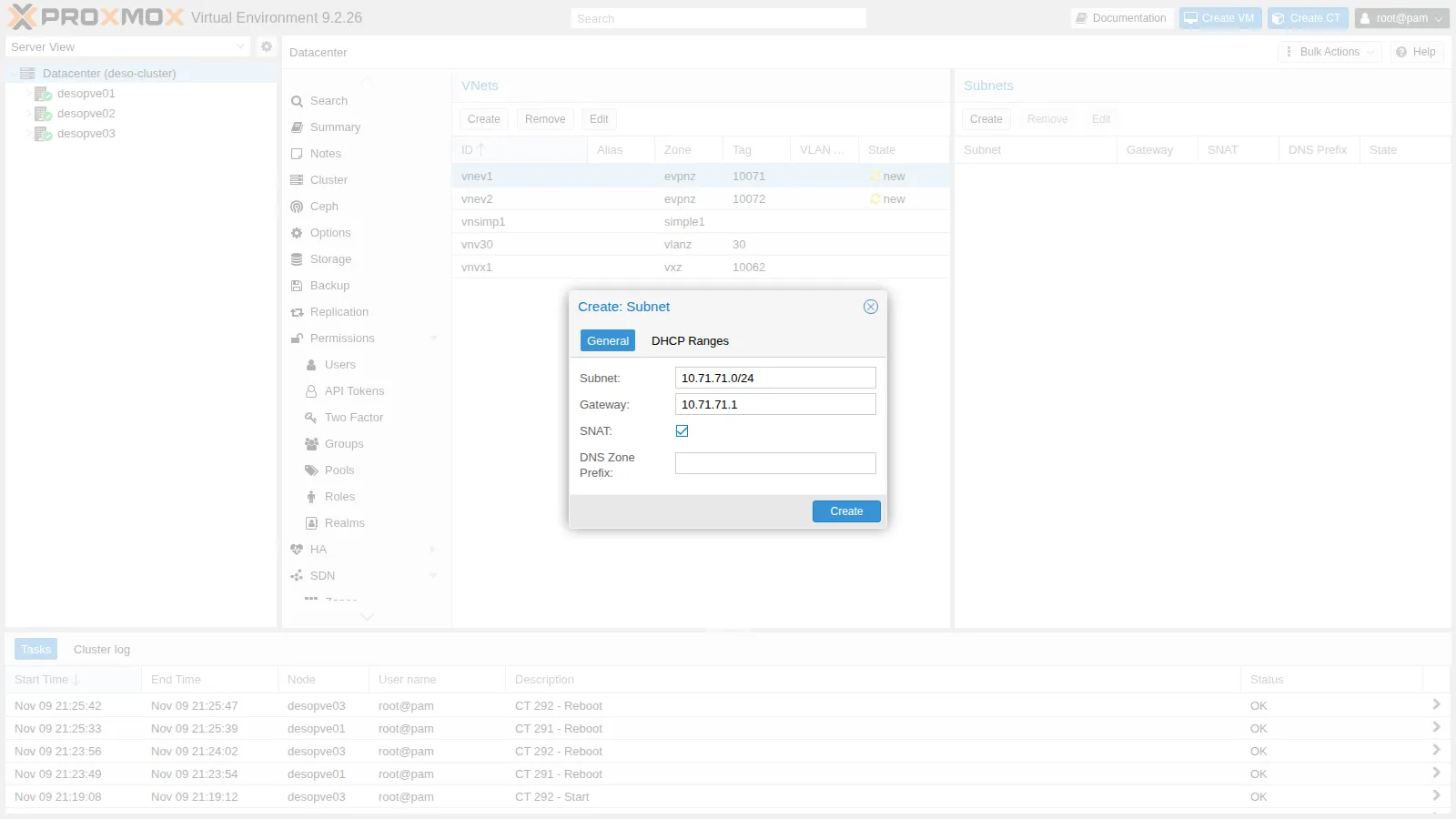
-
The second VNet from the command line, then Apply:
root@desopve01 pvesh create /cluster/sdn/vnets --vnet vnev2 --zone evpnz --tag 10072pvesh create /cluster/sdn/vnets/vnev2/subnets --subnet 10.72.72.0/24 --type subnet --gateway 10.72.72.1 --snat 1pvesh set /cluster/sdn
4. What the SDN generates: FRR, VRF and gateway
Section titled “4. What the SDN generates: FRR, VRF and gateway”-
In
/etc/frr/frr.confthe SDN writes the VRF with its VNI, the iBGP sessions between the nodes with BFD, and the advertisement of all VNIs. On the exit nodes it adds the default route advertised into the zone:# excerpt of /etc/frr/frr.conf on desopve01 (exit node)vrf vrf_evpnzvni 10070exit-vrf!router bgp 65000bgp router-id 10.61.10.21neighbor VTEP peer-groupneighbor VTEP remote-as 65000neighbor VTEP bfdneighbor 10.61.10.22 peer-group VTEPneighbor 10.61.10.23 peer-group VTEP!address-family l2vpn evpnneighbor VTEP activateneighbor VTEP route-map MAP_VTEP_IN inneighbor VTEP route-map MAP_VTEP_OUT outadvertise-all-vniexit-address-familyexit!router bgp 65000 vrf vrf_evpnz!address-family l2vpn evpndefault-originate ipv4default-originate ipv6exit-address-familyexit -
The BGP sessions with the other two nodes and the known VNIs:
root@desopve01 vtysh -c "show bgp l2vpn evpn summary"Output BGP router identifier 10.61.10.21, local AS number 65000 VRF default vrf-id 0...Neighbor V AS MsgRcvd MsgSent TblVer InQ OutQ Up/Down State/PfxRcd PfxSnt Descdesopve02(10.61.10.22) 4 65000 25 31 3 0 0 00:00:37 3 7 FRRouting/10.6.1desopve03(10.61.10.23) 4 65000 25 24 3 0 0 00:00:30 5 7 FRRouting/10.6.1root@desopve01 vtysh -c "show evpn vni"Output VNI Type VxLAN IF # MACs # ARPs # Remote VTEPs Tenant VRF VLAN BRIDGE10072 L2 vxlan_vnev2 0 0 2 vrf_evpnz 1 vnev210071 L2 vxlan_vnev1 0 0 2 vrf_evpnz 1 vnev110062 L2 vxlan_vnvx1 2 2 2 default 1 vnvx110070 L3 vrfvx_evpnz 0 0 n/a vrf_evpnz 1 vrfbr_evpnzThe two L2 VNIs are the VNets, the L3 VNI belongs to the VRF. VNI 10062 of the lab 29 VXLAN zone also shows up: with
advertise-all-vni, FRR advertises every VXLAN interface on the node. -
The anycast gateway: same IP and same MAC on
desopve01anddesopve03:root@desopve01 ip -br link show vnev1Output vnev1 UP bc:24:11:f3:ac:a9 <BROADCAST,MULTICAST,UP,LOWER_UP>root@desopve03 ip -br link show vnev1Output vnev1 UP bc:24:11:f3:ac:a9 <BROADCAST,MULTICAST,UP,LOWER_UP>root@desopve03 ip -br -4 addr show vnev1Output vnev1 UP 10.71.71.1/24
5. Guests in different VNets on different nodes
Section titled “5. Guests in different VNets on different nodes”-
CT 301 on
desopve01in thevnev1VNet and CT 302 ondesopve03in thevnev2VNet, with the subnet gateway and an MTU of 1450. As in lab 29, the MTU must also be written into the container’s network file, then the container is restarted:root@desopve01 pct create 301 cephfs:vztmpl/debian-13-standard_13.6-1_amd64.tar.zst --hostname evpn-ct1 \--unprivileged 1 --features nesting=1 --cores 1 --memory 512 --rootfs rbd-vm:4 \--net0 name=eth0,bridge=vnev1,ip=10.71.71.11/24,gw=10.71.71.1,mtu=1450 --passwordpct start 301pct exec 301 -- sed -i '/address 10.71.71.11/a\ mtu 1450' /etc/network/interfacespct reboot 301root@desopve03 pct create 302 cephfs:vztmpl/debian-13-standard_13.6-1_amd64.tar.zst --hostname evpn-ct2 \--unprivileged 1 --features nesting=1 --cores 1 --memory 512 --rootfs rbd-vm:4 \--net0 name=eth0,bridge=vnev2,ip=10.72.72.12/24,gw=10.72.72.1,mtu=1450 --passwordpct start 302pct exec 302 -- sed -i '/address 10.72.72.12/a\ mtu 1450' /etc/network/interfacespct reboot 302 -
CT 302 reaches CT 301 in another VNet and on another node. The first hop is the anycast gateway on the local node; the second, the remote node, does not answer traceroute:
root@desopve03 pct exec 302 -- ping -c3 -W1 10.71.71.11Output 3 packets transmitted, 3 received, 0% packet loss, time 2031msroot@desopve03 pct exec 302 -- apt-get install -y traceroute # the CT goes out through the exit node; apt proxy set as in the other guestspct exec 302 -- traceroute -n -w1 -q1 10.71.71.11Output traceroute to 10.71.71.11 (10.71.71.11), 30 hops max, 60 byte packets1 10.72.72.1 0.130 ms2 *3 10.71.71.11 1.096 msroot@desopve03 pct exec 302 -- ip neigh show 10.72.72.1Output 10.72.72.1 dev eth0 lladdr bc:24:11:f3:ac:a9 REACHABLE -
On node
desopve03, which is not an exit node, the VRF table contains the default route toward the primary exit node and a /32 route for each remote guest, learned from BGP:root@desopve03 vtysh -c "show ip route vrf vrf_evpnz"Output ...B>* 0.0.0.0/0 [200/0] via 10.61.10.21, vrfbr_evpnz onlink, weight 1, 00:02:34K * 0.0.0.0/0 [255/8192] unreachable (ICMP unreachable), weight 1, 00:02:39C>* 10.71.71.0/24 is directly connected, vnev1, weight 1, 00:02:39L>* 10.71.71.1/32 is directly connected, vnev1, weight 1, 00:02:39B>* 10.71.71.11/32 [200/0] via 10.61.10.21, vrfbr_evpnz onlink, weight 1, 00:00:19C>* 10.72.72.0/24 is directly connected, vnev2, weight 1, 00:00:30L>* 10.72.72.1/32 is directly connected, vnev2, weight 1, 00:00:30 -
The type 2 routes with the guests’ MACs and IPs:
root@desopve01 vtysh -c "show bgp l2vpn evpn route type macip"Output ...Route Distinguisher: 10.61.10.21:4*> [2]:[0]:[48]:[bc:24:11:ca:34:84]:[32]:[10.71.71.11] RD 10.61.10.21:4Route Distinguisher: 10.61.10.23:5*>i [2]:[0]:[48]:[bc:24:11:46:74:e2]:[32]:[10.72.72.12] RD 10.61.10.23:5
6. Leaving through the exit node with SNAT
Section titled “6. Leaving through the exit node with SNAT”-
CT 302 reaches the domain controller, outside the zone. On the management network of
desopve01, the primary exit node, the traffic goes out with the node’s address:root@desopve03 pct exec 302 -- ping -c3 -W1 172.27.199.20Output 3 packets transmitted, 3 received, 0% packet loss, time 2003msroot@desopve01 tcpdump -lnni vmbr0 -c2 "icmp[icmptype]=icmp-echo and dst host 172.27.199.20"Output 21:40:37.078886 IP 172.27.199.21 > 172.27.199.20: ICMP echo request, id 282, seq 1, length 6421:40:38.080689 IP 172.27.199.21 > 172.27.199.20: ICMP echo request, id 282, seq 2, length 64 -
The SNAT rules were written by the SDN, on each exit node with its own address:
root@desopve01 iptables -t nat -S POSTROUTING | grep -E "10.7[12]"Output -A POSTROUTING -s 10.71.71.0/24 -o vmbr0 -j SNAT --to-source 172.27.199.21-A POSTROUTING -s 10.72.72.0/24 -o vmbr0 -j SNAT --to-source 172.27.199.21root@desopve02 iptables -t nat -S POSTROUTING | grep -E "10.7[12]"Output -A POSTROUTING -s 10.71.71.0/24 -o vmbr0 -j SNAT --to-source 172.27.199.22-A POSTROUTING -s 10.72.72.0/24 -o vmbr0 -j SNAT --to-source 172.27.199.22
7. Live migration with the anycast gateway
Section titled “7. Live migration with the anycast gateway”-
A VM from the Debian cloud image, with cloud-init (covered in depth in lab 40) and a network device that inherits the VNet MTU (
mtu=1):root@desopve01 qm create 303 --name evpn-vm1 --ostype l26 --memory 1024 --cores 1 \--net0 virtio,bridge=vnev1,mtu=1 --scsihw virtio-scsi-single \--scsi0 rbd-vm:0,import-from=local:import/debian-13-genericcloud-amd64.qcow2 \--ide2 rbd-vm:cloudinit --ipconfig0 ip=10.71.71.30/24,gw=10.71.71.1 \--ciuser labuser --cipassword '<lab-password>' --boot order=scsi0 --serial0 socket --vga serial0qm start 303qm showcmd 303 | grep -o 'host_mtu=[0-9]*'Output host_mtu=1450host_mtu=1450confirms that withmtu=1Proxmox VE passes the bridge MTU to the VirtIO device. -
Before the migration,
desopve03sees the VM’s MAC (bc:24:11:45:63:6d) behind the VTEP ofdesopve01:root@desopve03 vtysh -c "show evpn mac vni 10071"Output MAC Type Flags Intf/Remote ES/VTEP VLAN Seq #'sbc:24:11:ca:34:84 remote 10.61.10.21 0/0bc:24:11:45:63:6d remote 10.61.10.21 1/0 -
From CT 302, a ping every 100 ms toward the VM, while the VM live-migrates from
desopve01todesopve02:root@desopve03 pct exec 302 -- ping -i 0.1 -c 450 -q 10.71.71.30root@desopve01 qm migrate 303 desopve02 --onlineOutput ...2026-11-09 21:42:03 average migration speed: 512.4 MiB/s - downtime 45 ms2026-11-09 21:42:03 migration status: completed2026-11-09 21:42:07 migration finished successfully (duration 00:00:10)Output 450 packets transmitted, 440 received, 2.22222% packet loss, time 45465msThree observations, to be kept apart:
- Task: the migration took 10 seconds in all, and the task reports 45 ms of downtime, the pause of the VM measured by QEMU in the final phase.
- Ping: from CT 302, with one request every 100 ms, 10 replies are missing out of 450. The summary does not say whether they were consecutive; if they were, the gap lasted about one second.
- EVPN: after the migration,
desopve03sees the VM’s MAC behind the VTEP ofdesopve02(next step).
Interpretation: a gap of about one second, against a 45 ms pause, is consistent with the time the other nodes need to learn where the VM now is:
desopve02has to see a frame from the VM and advertise its MAC with a type 2 route, and the other nodes have to install it. The test does not time these steps one by one. How to check:ping -D -O -i 0.1timestamps every reply and reports the missing ones, so you can see whether they are consecutive and when they start compared with the task log; ondesopve02,tcpdump -eni vnev1 ether src bc:24:11:45:63:6dshows when the first frames of the VM reach the target node.The VM’s network configuration did not change: the gateway 10.71.71.1, with the same MAC, also exists on
desopve02. -
After the migration the MAC is behind the VTEP of
desopve02and the sequence number has increased: this is the EVPN MAC mobility mechanism.root@desopve03 vtysh -c "show evpn mac vni 10071"Output MAC Type Flags Intf/Remote ES/VTEP VLAN Seq #'sbc:24:11:ca:34:84 remote 10.61.10.21 0/0bc:24:11:45:63:6d remote 10.61.10.22 2/1 -
The VM was only needed for this test:
qm stop 303 && qm destroy 303 --purge.
8. Failure of the primary exit node
Section titled “8. Failure of the primary exit node”-
From CT 302, a continuous ping toward the domain controller. On
desopve01, bring down the underlay interface, as if the node disappeared from the network between the nodes (it stays up on the management network):root@desopve03 pct exec 302 -- ping -i 0.1 -c 300 -q 172.27.199.20root@desopve01 ip link set vmbr1.61 down -
After the failure, on
desopve03the default route of the VRF points to the backup exit node, and ondesopve02the traffic leaves with that node’s address:root@desopve03 vtysh -c "show ip route vrf vrf_evpnz 0.0.0.0/0"Output Routing entry for 0.0.0.0/0Known via "bgp", distance 200, metric 200, vrf vrf_evpnz, best* 10.61.10.22, via vrfbr_evpnz onlink, weight 1root@desopve02 tcpdump -lnni vmbr0 -c2 "icmp and host 172.27.199.20"Output 21:44:53.644292 IP 172.27.199.22 > 172.27.199.20: ICMP echo request, id 294, seq 37, length 6421:44:53.644875 IP 172.27.199.20 > 172.27.199.22: ICMP echo reply, id 294, seq 37, length 64These outputs are snapshots taken after the switch and do not say how long it took. The FRR log on
desopve03(journalctl -u frr) records when the session with 10.61.10.21 went down, and why. -
The ping that was already running did not behave the same way in every test. Over four attempts:
Test Replies lost The running ping 1 152 of 400, every 100 ms (about 15 s) no replies until the link was restored 2 4 of 150, every 200 ms (about 0.8 s) resumed through desopve023 132 of 300, every 100 ms (about 13 s) no replies until the link was restored 4 9 of 200, every 100 ms (about 0.9 s) resumed through desopve02The time in parentheses is computed, replies lost × interval: it assumes the losses were consecutive, which the ping summary does not show. In tests 2 and 4 the gap is consistent with the BFD detection time (about 900 ms) plus the route change, but the two were not timed separately.
Observed in tests 1 and 3. On
desopve02, the conntrack entry of the running ping had no address translation: in its reply half the destination is 10.72.72.12, the guest, instead of 172.27.199.22, the node, and the entry is[UNREPLIED]. For example:root@desopve02 conntrack -L -p icmp | grep 10.72.72.12Output icmp 1 29 src=10.72.72.12 dst=172.27.199.20 type=8 code=0 id=295 [UNREPLIED] src=172.27.199.20 dst=10.72.72.12 type=0 code=0 id=295 mark=0 use=1A new ping, started during the failure, has a different ICMP identifier and therefore gets a new entry. It worked with no loss:
root@desopve03 pct exec 302 -- ping -c5 -W1 172.27.199.20Output 5 packets transmitted, 5 received, 0% packet loss, time 4006msInterpretation. Without translation, the requests leave
desopve02with the guest’s private address, and the DC replies to 10.72.72.12, an address that no router outside the zone knows how to reach: this is consistent with[UNREPLIED]. Why the entry was created without NAT is a hypothesis. The first packets of the flow may have reacheddesopve02while its own default route in the VRF still pointed todesopve01: they would then not have left throughvmbr0, and would not have matched the SNAT rule (-o vmbr0). NAT is decided on the first packet of a flow, and an ICMP entry expires only after 30 seconds without traffic (nf_conntrack_icmp_timeout): a ping every 100 ms keeps it alive for as long as it runs. In tests 2 and 4 the events would have happened in the opposite order. The test did not record their timing.How to check:
- during a blocked test, run
tcpdump -lnni vmbr0 icmp and host 172.27.199.20ondesopve02: requests leaving from 10.72.72.12, with no replies, confirm the missing translation; conntrack -E -p icmp -o timestampondesopve02, together withip -ts monitor route, shows whether the entry was created before or after the node changed its default route;- delete the entry while the ping is blocked (
conntrack -D -p icmp -s 10.72.72.12): if the ping resumes right away, through SNAT, the stale entry was the cause.
- during a blocked test, run
-
Restore the link, and the BGP sessions come back up:
root@desopve01 ip link set vmbr1.61 upvtysh -c "show bgp l2vpn evpn summary" | grep ^desopveOutput desopve02(10.61.10.22) 4 65000 231 253 40 0 0 00:00:46 3 8 FRRouting/10.6.1desopve03(10.61.10.23) 4 65000 231 247 40 0 0 00:00:46 8 8 FRRouting/10.6.1
Decision and limits. The zone keeps SNAT with a primary exit node, the configuration the Proxmox VE documentation requires for SNAT with several exit nodes, and the upstream router rtr-core stays out of BGP, so as not to touch the lab infrastructure. A flow that is already open may therefore stay blocked when the exit moves, and the test shows that it does not happen every time. Two cases were not tested:
- TCP connections. ICMP tolerates the change of source address: the DC simply replies to
desopve02. A TCP connection opened throughdesopve01would instead reach the server, after the switch, from an address that belongs to no open connection, and would be expected to break. - An exit without SNAT. The exit nodes advertise the zone’s subnets via BGP to the upstream routers, which can then send the replies to any exit node, with no NAT state on the nodes. How long the switch takes in that configuration has to be measured on your own network.
Verification and tests
Section titled “Verification and tests”The lab has succeeded when every check in the table gives the expected result. The behavior of a flow that is already open during the failure is recorded rather than judged: in this test it was not repeatable.
| Check | Expected result | Observed in the test |
|---|---|---|
| EVPN iBGP sessions between the 3 nodes | established, with BFD | established |
| Anycast gateway | same IP and MAC on every node | 10.71.71.1 and bc:24:11:f3:ac:a9 on desopve01 and desopve03 |
CT 302 (vnev2, desopve03) → CT 301 (vnev1, desopve01) |
replies, routed in the VRF | 0% loss |
| Exit toward the DC | source address of the primary exit node | 172.27.199.21 |
| Live migration of VM 303 | migration completed, MAC behind the VTEP of the target node | task: 10 s, 45 ms of downtime; ping every 100 ms: 10 replies lost out of 450; MAC behind 10.61.10.22, sequence 2/1 |
| Underlay of the primary exit node down | default route via desopve02, new flows leaving with its address |
route via 10.61.10.22; new ping: 0% loss; running ping: 4 and 9 replies lost in two tests, no replies until the restore in the other two |
| Link restored | BGP sessions established again | both sessions up |
Final lab state
Section titled “Final lab state”- SDN:
- controller
evpnctl(EVPN, ASN 65000, peers 10.61.10.21-23 on VLAN 61); - zone
evpnz(VRFvrf_evpnz, VRF-VXLAN 10070, MTU 1450, exit nodesdesopve01as primary anddesopve02); - VNet
vnev1(VNI 10071, 10.71.71.0/24, gateway .1, SNAT) andvnev2(VNI 10072, 10.72.72.0/24, gateway .1, SNAT); - zones
simple1,vlanzandvxzunchanged.
- controller
- Containers, running, not set to start at boot, MTU 1450:
- CT 301
evpn-ct1ondesopve01, 10.71.71.11/24; - CT 302
evpn-ct2ondesopve03, 10.72.72.12/24.
- CT 301
- VM 303 deleted.
vmbr1.61is up again ondesopve01.
What you learned
Section titled “What you learned”- When EVPN is worth it over plain VXLAN: when the VNets have to route between each other on every node, with a VRF per tenant and the same gateway everywhere, and you want MACs and IPs distributed by BGP instead of learned by flooding the underlay (Lab 29).
- How to let the zone out: exit nodes with SNAT need nothing on the upstream routers, but with several exit nodes they require a primary one, and a failover can block flows that are already open. If open flows must survive the loss of an exit node, plan the routed alternative, with the subnets advertised via BGP, and test it on your network.
- How to run a failover test: keep the route switch, the gap seen by the client and the conntrack state apart; repeat the test several times, since the outcome here changed from one attempt to the next, and record timestamps (
ping -D -O, the FRR log,conntrack -E). - What to check after an exit node fails: the default route of the VRF on a node that is not an exit node, the source address on the backup node’s
vmbr0, and any conntrack entry without translation. A new flow tells you whether the exit works; the old one tells you whether stale state is in the way. - What a live migration costs in an EVPN zone: the guest keeps its gateway, but the gap a client sees, about one second here, is much longer than the pause reported by the task, and is measured with a timestamped ping.
References
Section titled “References”- Proxmox VE – SDN: EVPN zones, exit nodes and primary exit node
- Proxmox VE – SDN: EVPN controller
- Proxmox VE – SDN: subnets and the SNAT option
- Proxmox VE – SDN: multiple EVPN exit nodes and
rp_filter - RFC 7432 – BGP MPLS-Based Ethernet VPN
- RFC 7432, section 15 – MAC mobility and sequence numbers
- RFC 8365 – A Network Virtualization Overlay Solution Using EVPN
- FRRouting 10.6 – EVPN
- FRRouting 10.6 – BFD, default timers
- Linux 7.0 – conntrack parameters (
nf_conntrack_icmp_timeout) - conntrack(8) – listing, watching and deleting entries